
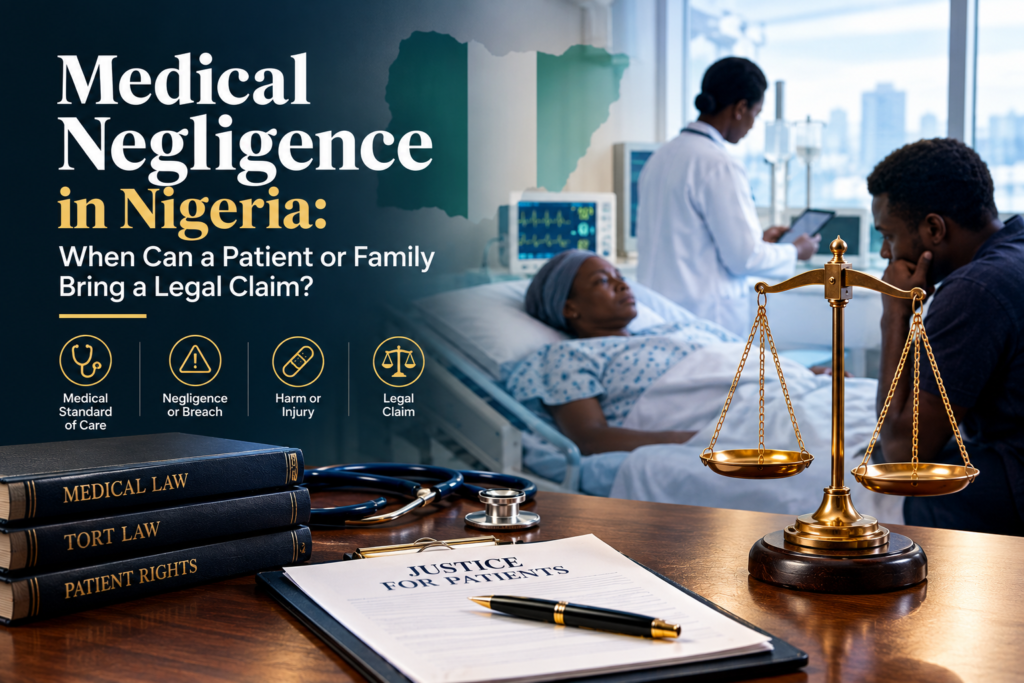
Medical Negligence in Nigeria: When Can a Patient or Family Bring a Legal Claim?
INTRODUCTION
WHEN MEDICAL TREATMENT CAUSES HARM
A patient enters a hospital expecting professional care. Instead, the patient suffers a preventable injury, receives the wrong treatment, experiences a serious delay in diagnosis or dies following care that may have fallen below an acceptable professional standard.
For the family, the questions are immediate: Was this an unavoidable medical complication, or was someone negligent? Who should be held responsible? Can compensation be claimed? And what happens if the hospital refuses to release the patient’s medical records?
These questions arise in both private and public healthcare settings across Nigeria.
Not every unsuccessful treatment amounts to medical negligence. Medical procedures carry risks, and a patient’s condition may deteriorate despite appropriate care. However, where a healthcare professional or institution breaches an applicable duty of care and causes legally recognisable harm, the affected patient may have grounds for a civil claim.
Nigerian law provides avenues for seeking compensation and, separately, for reporting professional misconduct. Understanding the distinction between an unfortunate outcome and actionable negligence is the first step towards protecting a patient’s rights.
WHAT IS MEDICAL NEGLIGENCE UNDER NIGERIAN LAW?
Medical negligence generally refers to a healthcare professional’s failure to exercise the degree of care and skill reasonably expected in the circumstances, resulting in injury or other legally recognised damage.
It may arise during diagnosis, surgery, prescribing medication, administering treatment, monitoring a patient, obtaining informed consent or providing post-operative care.
A claim will ordinarily require proof of three central elements:
1. Duty of care: The defendant owed the patient a duty to exercise appropriate care.
2. Breach of duty: The defendant failed to meet the applicable standard of care.
3. Causation and damage: The breach caused or materially contributed to a legally recognised injury or loss.
The Supreme Court’s decision in Universal Trust Bank of Nigeria Ltd v Ozoemena (2007) illustrates the general principles governing negligence: the claimant must establish the relevant duty, breach and resulting damage. In healthcare disputes, the precise professional standard and the connection between the alleged breach and the injury must be assessed against the evidence.
The fact that a patient died, suffered complications or failed to recover does not, by itself, establish negligence.
WHAT NIGERIAN LAWS GOVERN MEDICAL NEGLIGENCE?
Medical negligence claims may involve several sources of Nigerian law, depending on the facts.
1. The National Health Act 2014
The National Health Act 2014 provides an important statutory framework for healthcare delivery and patient rights in Nigeria.
Among other matters, the Act addresses informed consent, emergency treatment, confidentiality and the protection of health records. Sections 20–23 contain provisions relevant to users of health services and the responsibilities and rights of healthcare providers; sections 26–29 address confidentiality, access to and protection of health information and records.
These provisions can be relevant where a dispute concerns whether a patient was properly informed, whether emergency treatment was provided, or whether health information was handled lawfully.
The Act does not mean that every breach of a patient-related obligation automatically establishes a successful claim for damages. The particular provision, the facts, the available remedy and the evidence must be considered.
2. The Medical and Dental Practitioners Act and professional rules
The Medical and Dental Practitioners Act establishes the framework for regulating medical and dental practitioners in Nigeria. The Medical and Dental Council of Nigeria (MDCN) oversees professional standards and disciplinary processes within its statutory remit.
Where a complaint concerns a doctor’s professional conduct, the patient or family may consider a formal complaint to the MDCN in addition to any appropriate civil proceedings.
Professional discipline and civil compensation are distinct. A disciplinary complaint is not a substitute for a properly constituted damages claim, and a civil claim does not automatically establish that a practitioner should be professionally disciplined.
3. The law of negligence and applicable procedural legislation
Civil claims may be founded on negligence, breach of an applicable contractual obligation, or other legally recognised grounds, depending on the circumstances.
The appropriate court, parties, filing requirements and limitation period depend on the nature of the claim, the identity and legal status of the defendant, the reliefs sought and the applicable legislation.
For this reason, a claim against an individual doctor, a private hospital, a state-owned facility or a federal healthcare institution should not automatically be approached in the same way.
WHEN CAN A PATIENT BRING A MEDICAL NEGLIGENCE CLAIM?
A patient may have grounds to investigate a claim where the available evidence suggests that a healthcare professional or institution failed to provide appropriate care and that the failure caused injury or loss.
The following examples illustrate situations that may warrant investigation. None establishes negligence automatically.
1. Misdiagnosis or delayed diagnosis
A condition may be missed or diagnosed late despite symptoms, examination findings or test results that should reasonably have prompted further investigation.
For example, a patient may repeatedly report symptoms suggesting a serious condition, but the healthcare team fails to investigate them appropriately. If the delay causes avoidable deterioration, additional treatment costs or permanent injury, a claim may arise.
The relevant questions include what information was available at the time, what a reasonably competent professional would have done, and whether timely diagnosis would probably have changed the outcome.
2. Surgical errors or preventable procedural injuries
Potential concerns include operating on the wrong site, leaving a foreign object inside a patient, or making an avoidable error during a procedure.
The Supreme Court considered a surgical foreign-object allegation in Ojo v Gharoro (2006). The case is a useful reminder that the facts, evidence and applicable legal principles must be examined carefully in surgical negligence disputes.
Not every complication during surgery proves negligence. The circumstances of the procedure, the relevant professional standard and the causal connection to the injury remain important.
3. Medication and treatment errors
A claim may warrant investigation where a patient receives the wrong medication, an inappropriate dosage, or treatment administered without reasonable checks in the circumstances.
The same applies where a healthcare provider fails to take account of relevant allergies, known contraindications or material information in the patient’s records.
The legal question is not simply whether an error occurred, but whether the conduct breached the applicable standard and caused harm.
4. Failure to monitor or respond to deterioration
Appropriate care may require monitoring a patient’s condition, reviewing test results, responding to warning signs or arranging timely referral.
A failure to respond to significant deterioration may expose a patient to avoidable injury. The records should be examined to determine what warning signs were present, when staff became aware of them, what action was taken and whether a different response would likely have affected the outcome.
5. Inadequate informed consent
A patient should not be treated as having agreed to every procedure merely because they attended a hospital.
Section 23 of the National Health Act 2014 addresses informed consent to healthcare services, subject to the statutory framework and applicable exceptions. Consent-related disputes may arise where a patient alleges that material information was withheld or that consent was not properly obtained.
The assessment depends on the procedure, the information communicated, the patient’s decision-making capacity, the documentation and any applicable emergency or other lawful exception.
An adverse outcome does not automatically prove that consent was invalid, just as a signed consent form does not necessarily resolve every question about the consent process.
6. Negligence by a hospital or healthcare institution
Responsibility may extend beyond the individual practitioner where the evidence establishes an actionable failure attributable to the institution.
Depending on the facts, the issues may include staff supervision, nursing care, patient monitoring, equipment, record-keeping, referral arrangements or the conduct of personnel for whom the institution is legally responsible.
The correct defendant must be identified from the facts and applicable law. A hospital is not automatically liable for every act of every professional who treats a patient on its premises.
CAN A FAMILY BRING A CLAIM IF THE PATIENT DIES?
Potentially, yes. However, the proper claimant and legal basis must be identified.
Where a patient dies following suspected negligence, the circumstances may support a claim relating to the deceased’s estate, a claim for the benefit of eligible dependants under applicable fatal-accident legislation, or another legally available remedy.
These routes are not interchangeable. They may have different requirements concerning who can sue, the losses recoverable, the evidence needed and the time for commencing proceedings.
A family member does not automatically acquire authority to bring every claim simply because they are related to the deceased. Questions concerning the estate, personal representatives, eligible dependants and the appropriate parties must be resolved under the applicable law.
The family should preserve the medical records, death certificate, receipts and other relevant documents. An independent review of the treatment and cause of death may also be important.
Where a death occurs in suspicious circumstances, a civil claim is not the same as a criminal investigation or an inquest where one is legally available.
WHAT MUST BE PROVED TO WIN A MEDICAL NEGLIGENCE CLAIM?
A persuasive claim ordinarily requires more than an account of what went wrong.
Evidence of the applicable standard of care
The court must be able to assess the conduct of the relevant healthcare professional against the appropriate standard in the circumstances. Expert medical evidence may be important, particularly where the issue involves a specialist procedure, a disputed diagnosis or a complex causal question.
The precise evidence required depends on the issues in dispute; it would be inaccurate to suggest that every conceivable medical negligence claim has an identical evidential requirement.
Evidence of breach
The claimant must identify the act or omission said to constitute negligence. Relevant material may include clinical notes, medication charts, test results, consent forms, referral records and evidence from people involved in the patient’s care.
Evidence of causation and loss
The claimant must establish the legally required connection between the alleged breach and the injury or loss. This may require medical evidence addressing what probably caused the injury and whether the outcome would likely have differed with appropriate care.
Where compensation is sought, supporting documents should identify the financial and other legally recoverable consequences of the injury.
WHAT COMPENSATION OR OTHER REMEDIES MAY BE AVAILABLE?
Depending on the facts, the applicable law and the evidence, a successful claimant may seek damages for legally recoverable losses.
These may include reasonable medical and rehabilitation expenses, additional care costs, loss of earnings or earning capacity, and damages for pain, suffering or other recognised personal injury consequences.
In a fatal case, recoverable losses depend on the legal basis of the claim and the persons entitled to bring it.
The court determines the appropriate relief based on the evidence and applicable law. There is no universal compensation figure for medical negligence in Nigeria, and a particular sum should not be treated as guaranteed simply because a similar amount has been claimed in another case.
HOW TO PURSUE A MEDICAL NEGLIGENCE COMPLAINTS IN NIGERIA
A practical approach begins with preserving evidence and identifying the legal issues before deciding on the appropriate remedy.
Step 1: Prioritise medical care. If the patient remains at risk, seek appropriate medical attention or a second opinion. Evidence preservation should not delay urgent treatment.
Step 2: Request the relevant records. Make a written request to the healthcare institution for available medical records and relevant documentation. Sections 25–29 of the National Health Act are relevant to health-record access, confidentiality and protection. Access and disclosure remain subject to the applicable statutory requirements.
Step 3: Prepare a chronology. Record the dates of consultations, procedures, symptoms, test results, complaints, communications and subsequent treatment. Keep copies of correspondence and proof of payment.
Step 4: Obtain an independent review. Where appropriate, consult a suitably qualified medical expert to assess the treatment, the alleged departure from the applicable standard and causation.
Step 5: Obtain legal advice on the proper claim. A lawyer should assess the potential defendants, legal basis, available remedies, limitation periods, applicable court rules and any mandatory pre-action requirements or statutory notices.
Step 6: Consider a regulatory complaint or negotiated resolution. A complaint to the MDCN may be appropriate where professional conduct is in issue. A written demand or settlement discussion may also be considered where strategically suitable. Neither should be allowed to jeopardise a filing deadline.
Step 7: Commence proceedings where appropriate. If the matter cannot be resolved and the evidence supports a claim, proceedings may be commenced in the court with the appropriate jurisdiction, following the applicable procedural requirements.
There is no single procedure that applies identically to every medical negligence dispute.
MEDICAL NEGLIGENCE CLAIMS: IMPORTANT DOCUMENTS TO PRESERVE
Use this checklist when preparing for a legal assessment:
– [ ] Patient’s hospital file, clinical notes and discharge summary.
– [ ] Laboratory results, scans, imaging reports and prescriptions.
– [ ] Consent forms and available records of discussions about treatment.
– [ ] Operation notes, anaesthesia records and nursing charts, where relevant.
– [ ] Referral letters, follow-up notes and second-opinion reports.
– [ ] Receipts for treatment, medication, transport and rehabilitation.
– [ ] Evidence of income loss, additional care needs or other claimed losses.
– [ ] Emails, letters, messages and written complaints to the hospital.
– [ ] Death certificate and relevant estate or dependant documentation, where applicable.
– [ ] A dated chronology of events and names of relevant witnesses.
Keep originals safe and retain copies of everything submitted or received. Do not alter medical records or publish sensitive allegations and patient information online as a substitute for a formal complaint.
LIMITATION PERIODS: WHY EARLY LEGAL ADVICE MATTERS
One of the most significant risks in a potential medical negligence claim is missing the applicable statutory deadline.
Limitation periods in Nigeria are not governed by one uniform rule for every healthcare dispute. The relevant period may depend on the state or territory, the legal basis of the action, the type of loss, the date the cause of action accrued and the identity or legal status of the defendant.
Claims involving public healthcare institutions or public officers require particular care because statutory protections, pre-action notices and special procedural requirements may arise. Whether a particular protection applies must be determined from the legislation and the circumstances; it should not be assumed either to apply automatically or to be irrelevant.
A patient should not assume that the deadline begins only when a doctor admits an error or when the patient obtains an expert report. Nor should a family assume that a claim can be filed at any time because the injury was discovered late.
The applicable limitation law and any potential exception must be checked promptly. A claim may face a serious procedural obstacle if proceedings are commenced after the governing period has expired.
COMMON MISTAKES THAT CAN WEAKEN A CLAIM
Patients and families should avoid the following:
– Assuming every poor outcome proves negligence. The case must be supported by evidence of breach and causation.
– Relying only on verbal explanations. Preserve written records and make appropriate formal requests.
– Delaying because the hospital promised an internal investigation. An investigation or settlement discussion may not suspend the limitation period.
– Naming only the doctor without examining institutional responsibility. The proper parties depend on the facts and applicable law.
– Assuming a regulatory complaint guarantees compensation. Professional discipline and civil remedies are distinct.
– Posting unverified accusations publicly. Public allegations can create separate legal and privacy risks.
– Waiting too long to seek advice. Delay can affect evidence, witness availability and the ability to commence proceedings in time.
WHEN SHOULD YOU CONSULT A LAWYER?
Legal advice may be appropriate where a patient has suffered a serious or unexplained injury, a procedure appears to have been performed improperly, there are concerns about informed consent, a hospital refuses a reasonable records request, or a patient has died following potentially avoidable failures in care.
It may also be necessary where the healthcare provider is a government institution, the treatment occurred in more than one state, or there is uncertainty about the proper claimant, defendant, court or filing deadline.
A preliminary legal assessment can help determine whether the available facts justify further investigation, what evidence should be obtained, which remedies may be available and what procedural risks must be addressed.
FREQUENTLY ASKED QUESTIONS
1. Can I sue a hospital in Nigeria for medical negligence?
Potentially, yes. The evidence must establish an actionable legal basis for the claim and the hospital’s responsibility for the relevant conduct. The appropriate defendant and court depend on the circumstances.
2. Can I sue a doctor for a wrong diagnosis?
A wrong diagnosis does not automatically establish negligence. The key questions include whether the doctor acted with the care and skill reasonably expected in the circumstances and whether the alleged failure caused legally recognised harm.
3. Can I claim compensation if a relative dies because of suspected medical negligence?
Potentially. The correct claimant, legal basis, recoverable losses and applicable deadlines must be determined under the relevant law. A family relationship alone does not necessarily confer authority to pursue every available claim.
4. Do I need an independent medical expert?
Expert evidence may be important in establishing the applicable professional standard, breach and causation. The need and scope of expert evidence depend on the issues and evidence in the particular case.
5. Can I complain to the Medical and Dental Council of Nigeria?
A complaint may be made through the MDCN’s official complaint channels where a doctor’s professional conduct is in issue. A regulatory complaint and a civil compensation claim serve different purposes and may be pursued separately where appropriate.
6. How long do I have to file a medical negligence claim?
There is no safe universal deadline to quote without knowing the relevant jurisdiction, defendant, legal basis and circumstances. Special rules may apply to public institutions or officers. Obtain advice promptly rather than waiting for the hospital to conclude an investigation.
7. What if the hospital refuses to release the patient’s medical records?
Make a written request, retain proof of submission and seek legal advice on the applicable access rights and procedures. The National Health Act addresses health-record access and confidentiality, but the patient’s circumstances and any applicable restrictions must be considered.
PROTECTING YOUR RIGHTS AFTER SUSPECTED MEDICAL NEGLIGENCE
A serious medical outcome deserves careful investigation, but a sound legal claim requires more than suspicion. It requires a clear assessment of the applicable professional standard, the available evidence, the cause of the injury, the responsible parties and the legal remedies that may be pursued.
Where you or a family member may have suffered harm following medical treatment, obtaining timely legal advice can help preserve important evidence and clarify the options available.
Our approach is evidence-led and commercially practical: identifying the relevant legal issues, assessing potential liability, preserving documentation and advising on appropriate resolution or litigation.
Contact our legal team to discuss the circumstances and determine the appropriate next steps.
Disclaimer: This article provides general information on Nigerian law as at October 2026. It is not a substitute for advice on the facts of a particular case. Applicable legislation, procedural rules, limitation periods and remedies should be independently verified for the relevant jurisdiction and circumstances.